
Search results
Rwanda: boosting employment through vocational training
Rwanda, which has been experiencing strong growth and rebuilding itself since 1994, is faced with a shortage of skilled labour. Its population is growing rapidly and youth unemployment is high, despit...
Publication
Published on
Myanmar
A large, predominantly rural country very rich in natural resources, Myanmar holds a strategic geographical position between the Indian subcontinent, China and Southeast Asia. Since 2012, Agence Franç...
Regions and countries

Socioeconomic and spatially-explicit assessment of Nature-related risks: the case of South Africa
This study introduces new methods for evaluating nature-related socioeconomic risks in the South African context, anchored on two main contributions. Firstly, it embarks on a multidimensional analysis...
Publication
Published on
How is training helping address the energy crisis in Pakistan?
The Mangla Hydropower Training Institute (HPTI) is a unique institution in Pakistan, providing about 500 engineers hands-on, field training in the specific field of hydropower. AFD is supporting not o...
Publication
Published on
AFD group and Jordan
AFD has been working in Jordan since 2006, primarily on issues related to climate change adaptation and social cohesion, through solidarity-based and sustainable investments. As key partners in the wa...
Publication
Published on
AFD & KfW activities in the context of Loss and Damage - Position paper
First mentioned in 1991, Loss and Damage (L&D) has become the third pillar of the climate negotiations within a few years. In the absence of an agreed UNFCCC definition, a number of competing framings...
Publication
Published on
Burundi : living with HIV
Around 2.9% of Burundi's population is HIV-positive, a figure that is probably underestimated. Through several projects, the AFD Group is supporting the activities of the National Association for the...
Publication
Published on
Preventing hunger with agroecology in Burundi
Training in agroecology has enabled Burundian farmer Ndayisaba Marie Goreth and her family to be more food secure and to simply eat better. They’re not alone: more than 9,000 farmers, 52% of them wome...
Publication
Published on
Burundi: raising awareness against violence from an early age
In Burundi, where primary schooling has been free since 2005, the NGO Play International uses sport to combat the causes of school drop-out (gender, disability and poverty). To reintegrate and keep ch...
Publication
Published on
The Commons- Overview in Arabic
An overview in Arabic of The Commons- Drivers of Change and Opportunities for Africa also available in French and in Swahili (overview).
Publication
Published on
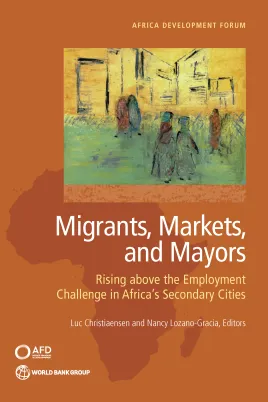
Migrants, Markets, and Mayors
Research on migration and urban development in Africa has primarily focused on larger cities and rural-to-urban migration. However, 97 percent of Africa’s urban centers have fewer than 300,000 inhabit...
Publication
Published on
Delivering public interest goods in Africa. Stopgap measures, state reform, and commons
Given the polysemy of the concept of “commons,” we use the concept of “public interest goods,” the content of which varies according to historical situations. In Africa, different institutions (modes...
Publication
Published on
A “shared earth” approach to put biodiversity at the heart of the sustainable development in Africa
Biodiversity is a classic example of a global commons. As we enter the coming decades of a rapidly changing climate, declining biodiversity, growing human populations and economic growth, sub-Saharan...
Publication
Published on
Private production or public project ownership to scale up the construction of photovoltaic power plants in Af...
Despite its abundant solar resources, Africa currently has low solar photovoltaic (PV) power generation capacities compared to other continents. Yet, the International Renewable Energy Agency (IRENA)...
Publication
Published on
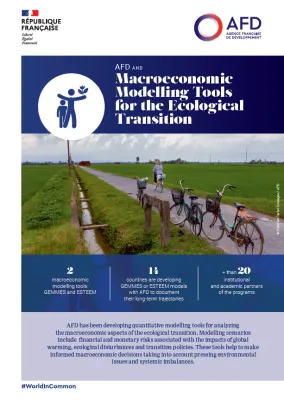
AFD and Macroeconomic Modelling Tools for the Ecological Transition
AFD has been developing two macroeconomic modelling tools – the GEMMES and ESTEEM models – for analysing the macroeconomic aspects of the ecological transition.
Publication
Published on
Global biodiversity scenarios: what do they tell us for Biodiversity-Related Financial Risks?
The risks associated with biodiversity loss could have severe socio-economic and financial consequences, at least as large as those imposed by climate change, in addition to interacting with them. Bec...
Publication
Published on
Biodiversity and financial instability with Julien Calas
The collapse of biodiversity threatens the financial system because there are two types of crisis: the physical crisis and the transition crisis. Whatever the type of crisis, if the problem becomes wi...
Publication
Published on
History of evaluation : Conservation Trust Funds
As the pressure on natural environments continues to increase, mobilising funding for biodiversity conservation is a major challenge. In this context, Conservation Trust Funds are important tools for...
Publication
Published on
Sustainable energy in Eastern Africa: the importance of regional integration
Jérémy Gasc, Energy Task Team Leader for Eastern Africa at AFD, details the potential of regional integration for the development of green energy in the region, but also AFD's actions to support this...
Publication
Published on
ARPEJ, an initiative for youth employment in Africa
In the current post-Covid-19 context and global economic crisis, young people, particularly in Africa, are facing increasing difficulties in training and access to employment. To address this urgent n...
Publication
Published on